.avif)
Probation Before Judgment in Delaware: A Complete Guide
Delaware is a vibrant state with a diverse population ranging from the busy streets of Wilmington to the quiet coastal towns of Sussex County. People here value community and fairness, which is reflected in how the local courts handle minor legal mistakes.
Residents often look for probation before judgment in Delaware to protect their futures and keep their records clean.
In this guide, we will discuss how the Delaware PBJ program offers a second chance to those who qualify.
You will learn how the legal system supports rehabilitation over punishment through options like probation before judgment in DE.
Key Takeaways
- No Criminal Record: Successful completion ensures you have no criminal record.
- Court Supervision: You must follow the stay entry of judgment & probation conditions.
- Future Clearing: Most cases qualify for probation before judgment or expungement under Delaware.
- One-Time Chance: This option is usually for first offenders only.
The Fundamentals of the Delaware PBJ Program
In some cases, a judge might decide to keep your case on hold rather than finding you guilty. This process is one of the most common sentencing alternatives available in the state today. It usually applies when a person faces a minor misdemeanor or a simple violation.
The court gives you a chance to prove that you can follow the law. You will be under supervision for a set amount of time.
If you finish this time without having any additional issues, the court removes the charges. This program helps many people keep their jobs and housing.
- You must often plead "no contest" or "guilty."
- The judge does not sign the judgment of conviction.
- A probation officer may check on your progress regularly.
[h2]Legal Requirements Under the probation before judgment statute in Delaware
State law sets very clear rules for who can use this option. A first offender is usually the primary candidate for this type of relief. Most eligible cases involve a misdemeanor or a low-level violation rather than a serious felony. The law ensures that people who make a small mistake have a chance to fix it.
Individuals must ask for this status before the court enters a final judgment. Prosecutors often review the facts of the case to see if they agree with the request. You may need to provide background information to prove you deserve this second chance.

Regional Court Procedures and New Castle County probation before judgment
Attorneys frequently handle Probation Before Judgment (PBJ) cases across Delaware's local court systems. Due to its population density, Wilmington, in New Castle County, sees a significant number of these applications.
Case processing times may vary slightly by location, but the same statewide PBJ standards apply in Kent, Sussex, and New Castle. This unified legal framework ensures every citizen receives a fair chance, regardless of their specific location within the state. Choosing a PBJ path can be critical for protecting professional licenses and future opportunities.
Attorneys frequently handle Probation Before Judgment (PBJ) cases across Delaware's local court systems, and procedures can vary by state.
The Role of the Clean Slate Act in Delaware
There is a law in Delaware called the Clean Slate Act that simplifies the process of removing public records. You can pursue an expungement once you finish the program to hide the arrest record from the public.
This leads to official probation before judgment expungement in Delaware, which clears your name in search databases. You must pay all your fines and restitution before the court will grant this request.
Receiving your official papers is a major milestone in your future. You should keep all your court paperwork to prove you have finished the requirements. This documentation is vital when you apply for a new job or a professional license in the future.
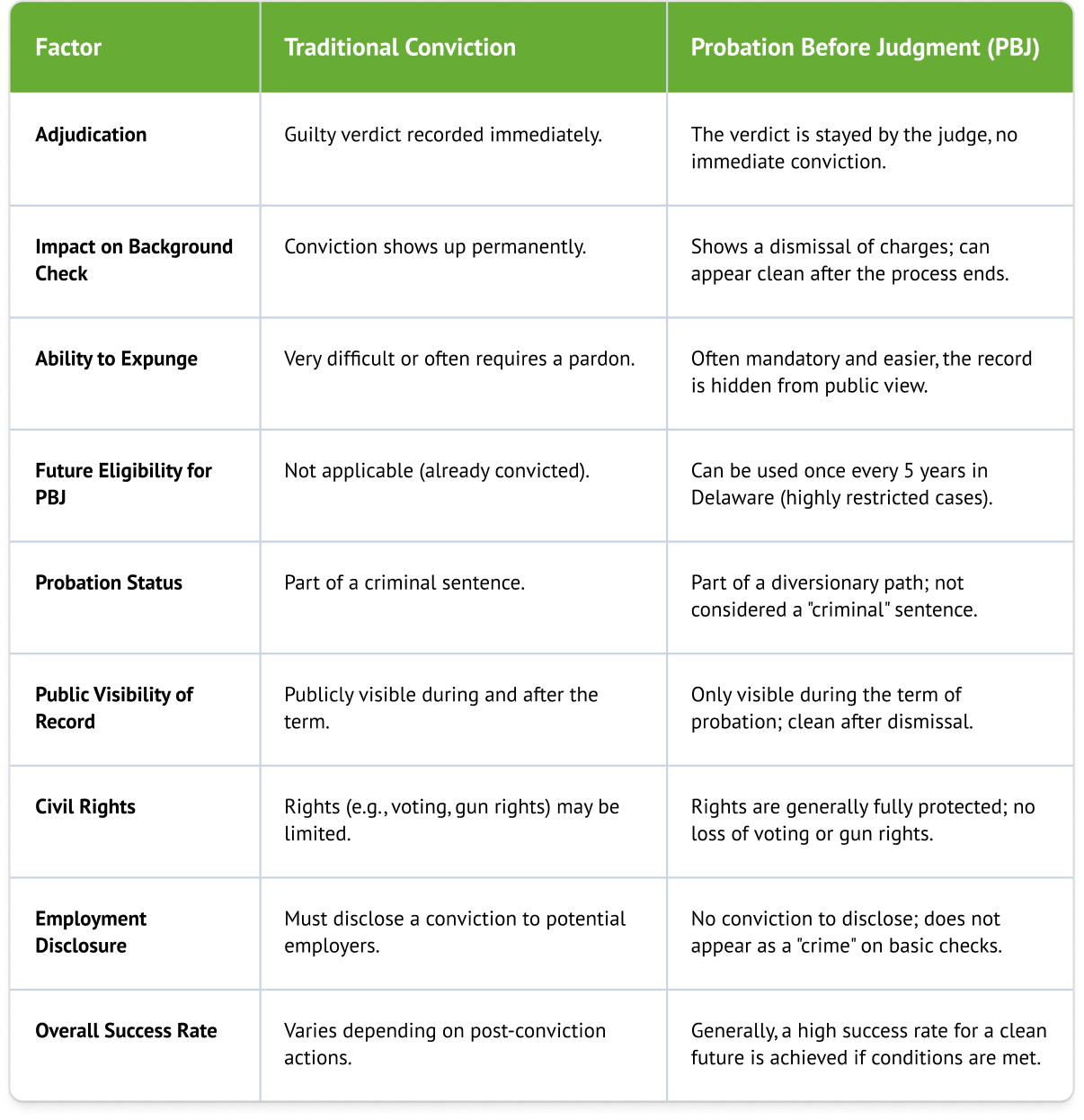
Differences Between Outcomes
This table highlights why choosing a diversion path is often better than a standard court result.
Conclusion
Recovery and personal growth are possible for everyone after a legal challenge. In Delaware, the concept of 'Probation Before Judgment' offers an opportunity for a clean slate, allowing you to avoid a conviction and build a strong future. This path emphasizes personal responsibility and proactive steps towards a positive life. Focused training and dedicated rehabilitation can play a crucial role in staying on the right path for years to come.
To find the professional support you need to navigate this process and rebuild your life today, visit CT3 Training & Rehab.
FAQs
Q1: What is probation before judgment in Delaware?
Under Title 11 of the Delaware Code, PBJ allows a judge to accept a guilty or no-contest plea while formally holding off on entering a conviction. The defendant serves probation under court-ordered conditions, and if everything is completed, the case is dismissed without a conviction ever being recorded. It's one of Delaware's primary tools for keeping non-violent first-time offenders out of the permanent criminal record system.
Q2: Does PBJ count as a conviction in Delaware?
No. Delaware law is clear on this. A PBJ disposition is not a conviction. The judgment is stayed, meaning the court never formally finds you guilty. That matters for employment applications, licensing, and public record purposes. It's also what separates PBJ from a suspended sentence, where a conviction is entered first and only the punishment gets delayed.
Q3: Who qualifies for PBJ in Delaware?
PBJ is primarily available to first-time offenders facing misdemeanor or low-level violation charges. Both the prosecutor and the judge have to agree. It can't simply be requested and received. Prior criminal history, prior diversion dispositions, and serious felony charges all tend to disqualify someone. The defendant also needs to acknowledge responsibility and formally agree to the program's conditions in writing.
Q4: How long does PBJ last in Delaware?
One year is the standard, though courts can set a shorter period depending on the case. The probationary period doesn't end early on its own. The court has to formally issue discharge papers after reviewing compliance. Until those papers are issued, every obligation remains in effect.
Q5: Can PBJ be expunged in Delaware?
Yes, and Delaware's Clean Slate Act has made this more accessible than it used to be. For most PBJ dispositions, expungement after case dismissal is mandatory. The court has to grant it, not simply consider it. You'll need to have paid all fines and restitution before filing. Once it goes through, the arrest and case record is removed from public criminal databases, and most standard background checks won't surface it afterward.
Q6: What are the typical conditions of PBJ in Delaware?
Conditions are set by the court and vary by case, but most people see some version of the same core requirements: staying out of trouble and avoiding new arrests, paying all fines and restitution owed to victims, completing community service hours, attending any required counseling or classes tied to the offense, and checking in with a probation officer on a regular schedule. Every item on that list has to be completed. One missed condition can unravel the entire arrangement.
Q7: Is DUI eligible for PBJ in Delaware?
Standard DUI/DWI charges don't qualify for the regular PBJ program. Delaware handles first-time DUI offenders through a separate track called the First Offender Program (FOP), which operates similarly in that successful completion can still result in avoiding a conviction, but it has its own eligibility rules, conditions, and timelines. Anyone facing a first DUI in Delaware should specifically ask their attorney about FOP eligibility, not standard PBJ.
Q8: What happens if you fail PBJ in Delaware?
The court revokes the stay-of-judgment, enters a formal conviction, and proceeds to standard sentencing on the original charge. The chance for a clean dismissal is gone permanently. Worth noting: even a technical violation such as a missed check-in or a late payment can trigger this process. A probation officer reports violations to the court, which then schedules a hearing. The threshold isn't reserved for major infractions.
.svg)


