.avif)
Short answer to “Is probation before judgment a conviction?”: No, PBJ is not considered a conviction in the traditional legal sense. But in practice, the difference is not always as straightforward as it seems.
While courts may not classify PBJ as a conviction, many employers, licensing boards, and other institutions may still view it as a record that carries consequences.
In this guide, we will walk you through exactly what does and does not happen to your criminal record when you accept PBJ, and what you can do about it.
Key Takeaways
- PBJ is not technically a conviction, but it is not a clean record either
- A guilty plea is usually required to receive PBJ
- It can show up on background checks depending on how they are run
- Expungement is possible in many cases after completing probation
- Violating PBJ conditions can lead to an actual conviction
Probation Before Judgment Meaning: The Basics
Probation before judgment is a deferred judgment option available in some states, most commonly Maryland, though it also applies in Virginia and Delaware. Here is how it works:
- You enter a guilty plea or an Alford plea in court
- The judge holds off on entering a formal conviction
- You complete a probationary period with specific conditions
- If you complete probation successfully, the case is dismissed without a conviction on record
Think of it as a second chance with conditions attached.
Is PBJ a Conviction? The Legal Answer
No, PBJ is not a conviction in the traditional legal sense. However, the distinction matters less than most people expect.
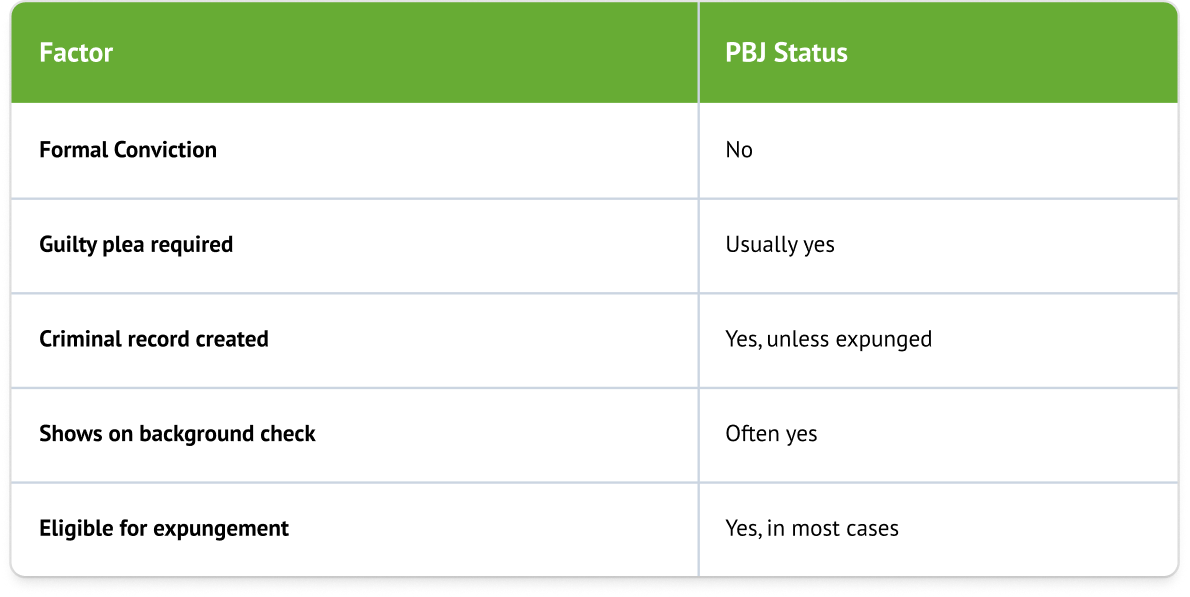
The legal status of PBJ is technically clear, but practically complicated. Courts do not treat it as a conviction, but many institutions do not treat it as a clean record either.
Does PBJ Show Up on a Background Check?
This is where probation before judgment becomes more complicated in real life. Even though PBJ is not technically considered a conviction, it can still appear on a background check depending on who is searching, how deeply they search, and what type of records they have access to.
Many people assume PBJ automatically disappears because there is no formal conviction entered. That is not always true. In many cases, the court record still exists unless the case is later expunged.
Here is how PBJ commonly appears across different types of background checks:
- Basic employer background checks:
Some standard employment screenings may not show a PBJ, especially if the employer uses limited databases or only looks for formal convictions. However, more detailed screenings can still uncover the court record. - Criminal court record searches:
PBJ often appears in county or state court databases because the case itself was filed in court. Even if the outcome was probation before judgment, the record of the charge and disposition may still be visible. - Federal or FBI-level background checks:
More advanced background investigations, including FBI fingerprint checks or federal security screenings, are much more likely to reveal a PBJ disposition. - Professional licensing boards:
Licensing agencies for healthcare workers, teachers, lawyers, financial professionals, and government employees may review PBJ records closely. Some boards treat PBJ similarly to a conviction when evaluating professional eligibility or character requirements. - Government and security clearance reviews:
Positions involving law enforcement, military service, government contracts, or security clearances often require disclosure of PBJ records, even when there is no formal conviction. - Immigration-related reviews:
Immigration authorities may also evaluate the underlying guilty plea or facts of the case rather than focusing only on whether a conviction was officially entered.
The safest approach is to assume PBJ can be discovered unless the record has been properly expunged. Relying on the idea that it will stay hidden can create problems later, especially during job applications, licensing reviews, or legal disclosures.
In many situations, completing probation successfully and pursuing expungement is the best way to reduce the long-term impact of a PBJ on your record.
Can Probation Before Judgment Be Expunged?
Yes, and this is the most important part. Record expungement is available for PBJ in many jurisdictions after probation is completed. Sealing records through expungement means:
- The charge is removed from public criminal databases
- Most employers will no longer see it
- You can legally deny the charge in many situations
Eligibility depends on the offense type and your state's laws. Non-violent and first-time offenses are far more likely to qualify.
Consequences of Probation Before Judgment If You Violate
Do not treat PBJ as a free pass. Violating the conditions of your probation before judgment carries real consequences:
- The judge can enter a formal guilty plea on your record
- You may face the original sentencing guidelines
- Your case dismissal option disappears entirely
Complete your probation. Every condition, every time.
Get the Support You Need to Complete Probation Successfully
Completing probation is the step that determines whether PBJ protects your future or becomes a conviction on your record. If you are navigating probation and need structured support, CT3 Training and Rehabilitation helps individuals meet court requirements and build a path forward.
Visit ct3training-rehab.com to learn how they can help you stay on track and protect your record.
FAQs
Q1: Is probation before judgment a conviction?
Not technically, no. PBJ sits in its own legal category. The court withholds the formal guilty finding while you serve a probationary period. Complete your probation and the case is dismissed without a conviction on file. But "not a conviction" doesn't mean "clean record." A guilty plea is usually required to receive PBJ, and plenty of institutions, including licensing boards, federal agencies, and immigration authorities, don't make the same fine distinction the court does. The legal answer and the practical answer aren't always the same thing.
Q2: Does probation before judgment show up on a background check?
It depends on who's looking and how deeply. A basic commercial employment check might miss it entirely, especially post-expungement. But the court case itself was filed and exists in the public record. County and state court searches will often surface it. FBI fingerprint checks and federal background investigations almost certainly will. Don't assume it's invisible just because there's no formal conviction attached. Until it's been properly expunged, treat it as discoverable.
Q3: Can probation before judgment be expunged?
Yes, and this is the step that actually closes the chapter. In most states where PBJ is available, expungement becomes an option once you've completed probation and the case is dismissed. After expungement, the record comes out of public criminal databases, most employers won't see it, and you can typically deny the charge legally in many contexts. Eligibility leans heavily toward non-violent, first-time offenses, and the specific rules vary by state.
Q4: What happens if you violate probation before judgment?
The judge revokes the PBJ and enters a formal guilty conviction. The original sentencing guidelines kick in at that point, including whatever penalties applied to the underlying charge. The path to dismissal closes permanently. PBJ isn't a free pass; it's a structured opportunity with real consequences attached. Every condition, every check-in, every class matters.
Q5: Does probation before judgment affect immigration status?
This is where people get caught off guard. Under federal immigration law (INA § 101(a)(48)(A)), immigration authorities can treat a guilty plea entered to obtain PBJ as a "conviction" regardless of what the state court called it. They look at the underlying admission and the facts of the case, not the court's procedural label. For any non-citizen considering PBJ, a conversation with an immigration attorney before entering a plea isn't optional. The stakes are too high to assume the immigration and criminal definitions will align.
Q6: Do you have to disclose probation before judgment on a job application?
Read the question carefully before answering it. If an application asks specifically about "convictions," PBJ generally doesn't require disclosure. It isn't one. If it asks about "arrests," "charges," "guilty pleas," or "pending matters," you likely do need to include it. Some jurisdictions have ban-the-box laws that restrict what employers can ask at the application stage. When the wording is ambiguous, err on the side of full disclosure or get legal guidance before submitting.
Q7: How is probation before judgment different from a standard conviction?
A conviction goes on your record immediately and stays there, affecting employment, housing, professional licenses, and in some cases voting rights. PBJ holds off on that entry entirely. Finish probation successfully and the case is dismissed. Pursue expungement and the record comes out of public view. The practical difference over a lifetime is substantial, which is why PBJ is worth pursuing if you're eligible and the charge qualifies.
Q8: What offenses are typically eligible for probation before judgment?
First-time, non-violent misdemeanors are the sweet spot: minor theft, simple possession, disorderly conduct, certain traffic offenses. Serious violent crimes and felonies are out. DUI/DWI is typically excluded from standard PBJ programs, though some states have separate diversion tracks for first-offense DUI. And if you've already received a PBJ or similar diversion disposition in the past, that prior participation usually disqualifies you from receiving another.
.svg)


