.avif)
Every state, city, or country operates under a different legal system, and Iowa is no different. If you are facing a charge in the Hawkeye State, you are likely worried about how a conviction will impact your job or your family.
Most people searching for deferred judgment in Iowa are looking for a way to take responsibility for a mistake without ruining their future. Managing the legal process can feel overwhelming, but Iowa law provides a specific path for those who qualify.
In this blog, we will talk about the specific rules that allow certain defendants to keep a conviction off their public record.
We will also highlight the basics of deferred judgment and how the local court system handles these cases. Understanding these local laws is the first step toward moving past a legal mistake and protecting your reputation.
Key Takeaways
- Definition: A deferred judgment allows you to avoid a permanent conviction if you complete probation.
- Eligibility: Only certain people qualify, usually those with a clean or minimal criminal record.
- Restrictions: Serious crimes and certain OWI offenses are not eligible for this program.
- The Process: You must plead guilty, follow strict probation rules, and pay all civil penalties.
- The Result: Successful completion results in a sealed record, while failure results in a permanent conviction.
What is a Deferred Judgment in Iowa?
A deferred judgment in Iowa is a unique sentencing option under the Iowa Code. When a judge grants this, you plead guilty, but the court does not formally enter a conviction on your record. Instead, the judge puts the case on hold while you prove you can follow the law.
The process typically involves the following steps:
- The Plea: The process begins with the plea agreement and hearing process, where you admit to the charge in front of a judge.
- The Probation: Instead of immediate jail time, the judge sets specific rules for you to follow during a period of supervision.
- The Reward: If you meet every requirement and stay out of trouble, you earn a full dismissal of charges after completion.
- The Risk: If you fail to follow the rules, the court can move toward a revocation of deferred judgment and sentence you for the original crime.
- The Authority: Ultimately, obtaining this second chance relies entirely on court discretion and judicial order.
Who Can Get a Deferred Judgment in Iowa?
A deferred judgment in Iowa lets eligible individuals avoid a conviction if they follow all court orders and complete the required terms.
Courts grant this relief only when a person meets the legal standards for eligibility for deferred judgment.
Eligibility Guidelines and Rules
- You must not have any felony convictions on your record at your sentencing.
- Your current charge must qualify under Iowa law, usually as a misdemeanor.
- A judge must approve your request based on your background and conduct.
- You must agree to and complete all probation terms ordered by the court.
Misdemeanor vs. Felony Eligibility
The following table outlines the technical differences regarding eligibility for deferred judgment based on the severity of the charge:

How Many Deferred Judgments in Iowa
- Iowa law allows no more than two deferred judgments in a lifetime.
- Courts deny any request for a third deferred judgment.
- The limit applies regardless of how much time has passed between cases.
- Each request still requires separate judicial approval.
The Requirements for Probation under a Deferred Judgment in Iowa
After the plea agreement and hearing process, probation begins. You must follow all probation conditions and supervision ordered by the judge to keep your case in good standing.
Courts typically require the following:
- Pay all restitution, fines, and community service hours on time
- Meet regularly with your probation officer
- Avoid any new criminal charges
- Complete all required programs, such as substance abuse treatment
You must also pay a civil penalty. The court often sets this amount equal to a criminal fine, but it labels it differently so it does not count as a conviction under the Iowa courts' authority.
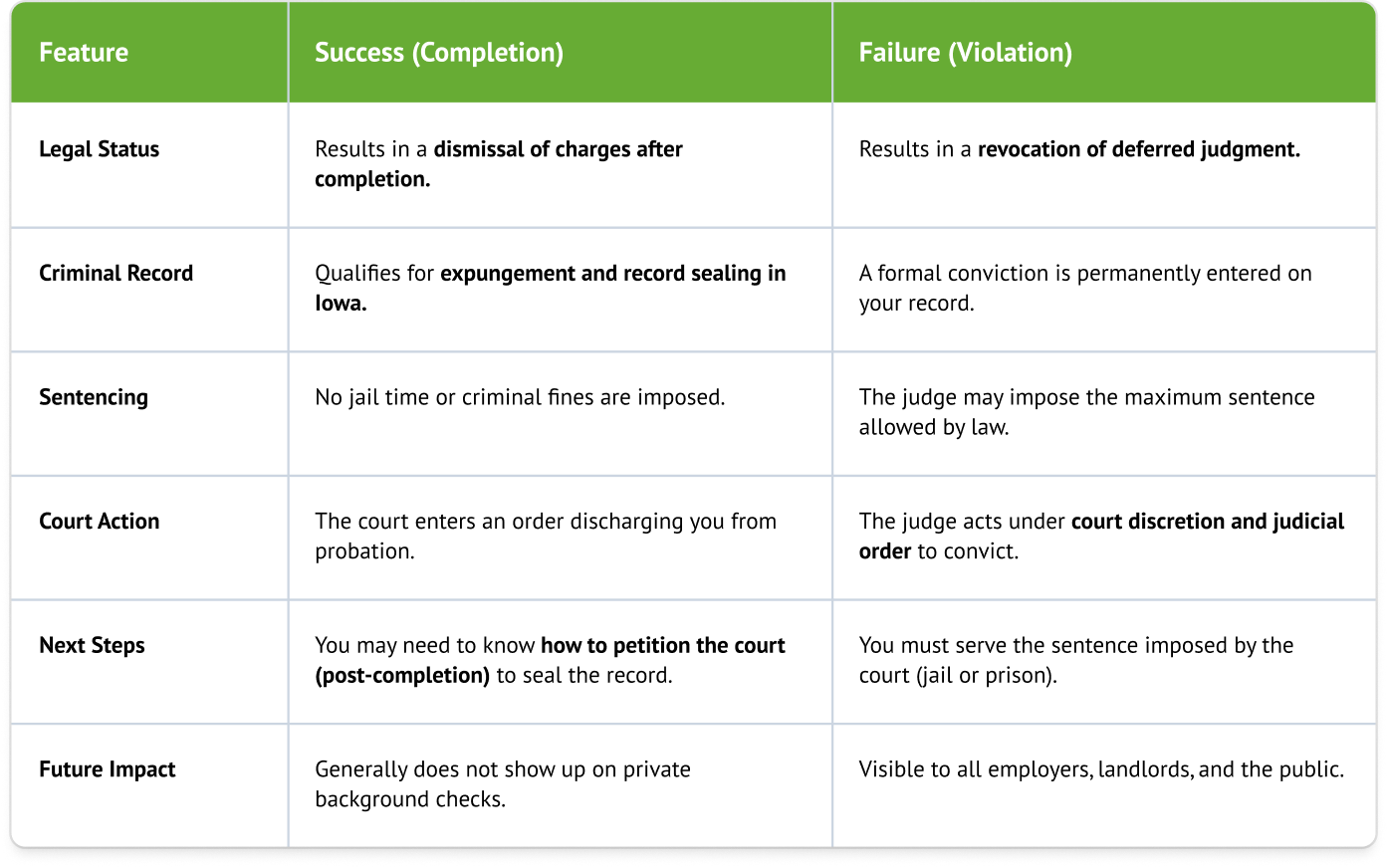
Success vs Failure under Iowa Deferred Judgment
Deferred Sentence vs Deferred Judgment
People often confuse deferred sentence vs deferred judgment, but the outcomes are very different.
A deferred judgment avoids a conviction if you succeed, and the court seals the record.
A deferred sentence records a conviction immediately and only delays punishment, such as jail time.
That conviction stays on your permanent record and does not qualify for expungement and record sealing in Iowa.
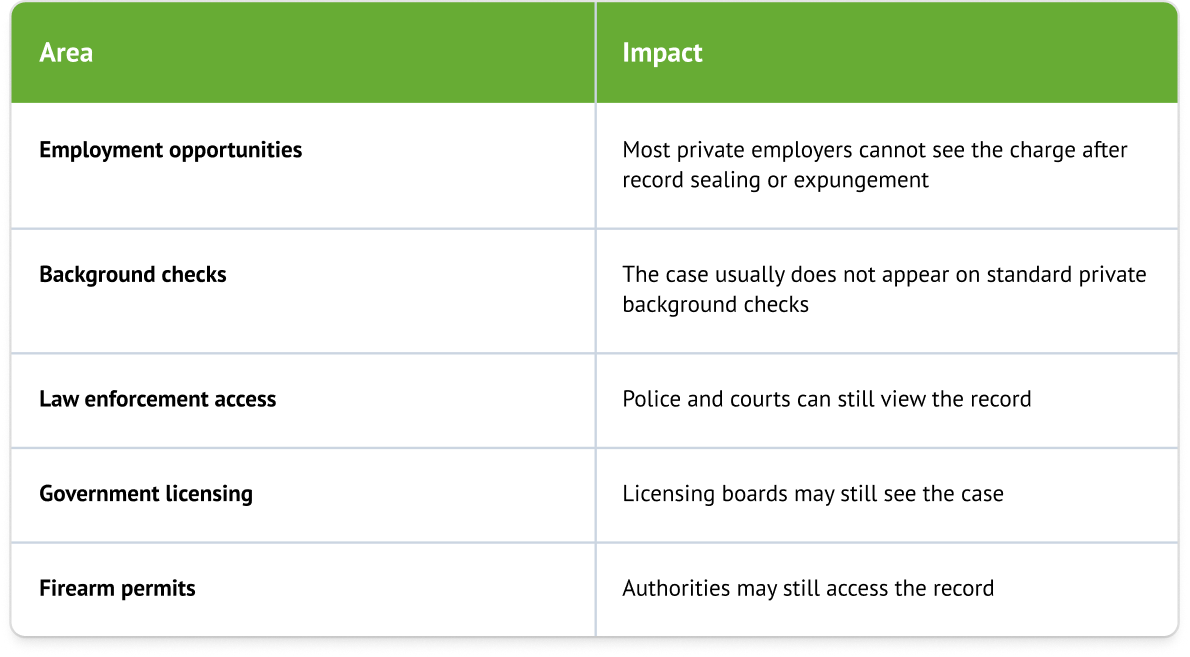
How It Affects Your Future with an Iowa Deferred Judgment
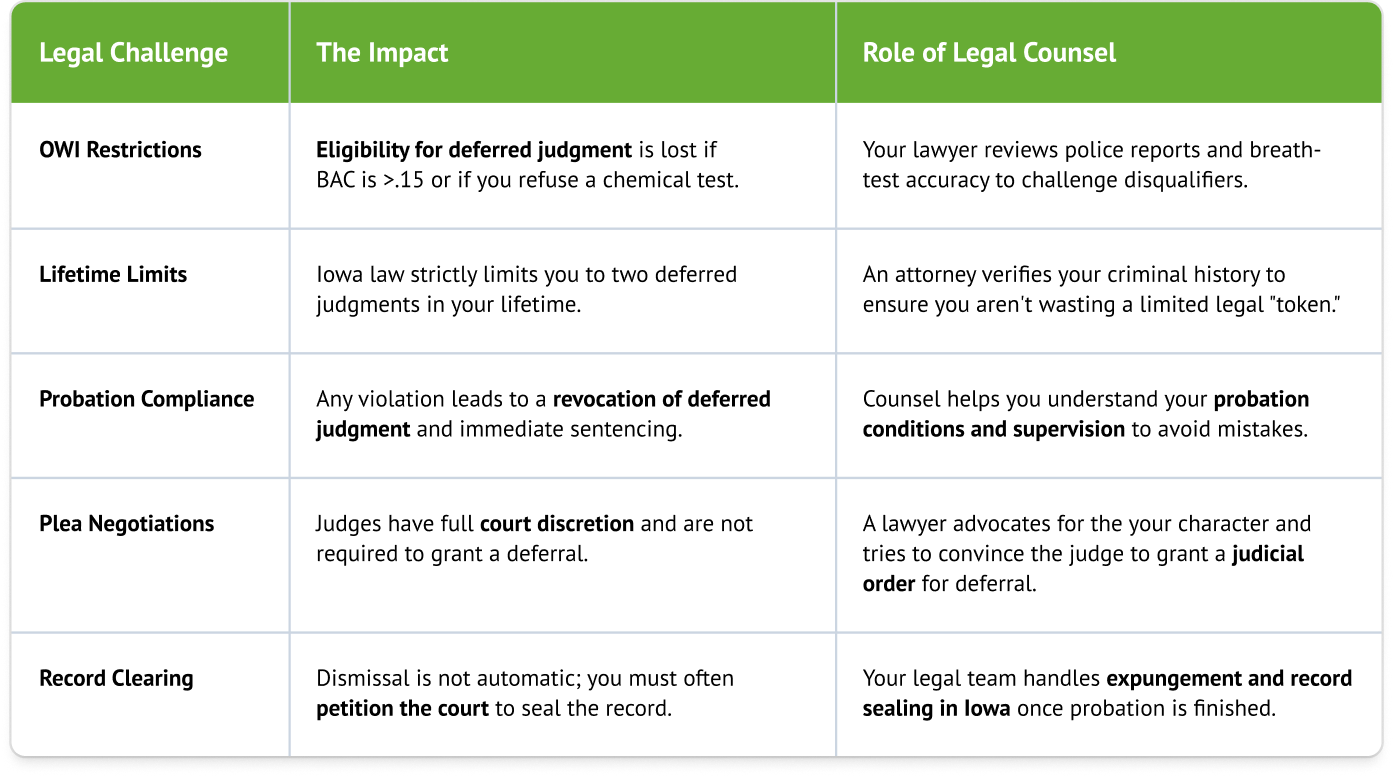
Why You Need Legal Help for a Deferred Judgment in Iowa
The table below explains why legal guidance is critical during the plea agreement and hearing process:
Take the Next Step
Protecting your future requires more than just court compliance. Building awareness, discipline, and long-term rehabilitation strengthens both your legal outcome and your personal growth.
You can also learn about how Probation before judgment works in delaware.
If you want structured support that complements legal compliance and personal accountability, explore the professional recovery and rehabilitation programs, or see how a similar process works in California, then visit https://www.ct3training-rehab.com/
CT3 Training helps individuals rebuild stability, responsibility, and long-term success after legal setbacks.
FAQs
Q1: What is a deferred judgment in Iowa?
Under Iowa Code § 907.3, a judge can accept your guilty plea without immediately entering a conviction. Your case is put on hold while you complete a probationary period. If you follow through on every condition the court sets, the charges are dismissed and your record is sealed. Nothing gets permanently recorded. It's a genuine second chance built into Iowa law, not a loophole, but a formal sentencing option designed for people who made a mistake and are willing to own it.
Q2: Is a deferred judgment a conviction in Iowa?
No, and that distinction matters enormously. When a judge grants a deferred judgment, the guilty finding is never actually entered into the record. You serve probation, and if you complete it, the case is dismissed cleanly. The conviction only materializes if you violate the terms. That's what separates a deferred judgment from other sentencing options: the outcome isn't predetermined. It depends entirely on what you do next.
Q3: Who qualifies for a deferred judgment in Iowa?
Three things generally need to be true: no prior felony on your record at the time of sentencing, a qualifying charge under Iowa Code § 907.3 (misdemeanors are the most common), and a judge who agrees you deserve the opportunity. That last part matters. The court has full discretion, and even if you technically qualify on paper, a judge isn't required to grant it. Serious violent felonies and certain repeat OWI offenses are off the table entirely.
Q4: How many deferred judgments can you get in Iowa?
Two. That's the lifetime cap under Iowa law, and it applies regardless of how long ago the first one was or how minor the offense. A third request will be denied. Each one still requires individual judicial approval, so reaching the limit doesn't guarantee anything. It just means you haven't been automatically locked out.
Q5: What is the difference between a deferred judgment and a deferred sentence in Iowa?
People confuse these constantly, and the difference is significant. A deferred judgment holds off on entering a conviction at all. Complete probation and there's nothing on your record. A deferred sentence enters the conviction immediately and only delays the punishment, such as jail time. That conviction stays permanently with a deferred sentence and won't qualify for expungement. If keeping your record clean is the priority, a deferred judgment is the only one of these two that actually achieves it.
Q6: Does a deferred judgment show up on a background check in Iowa?
During the probationary period, the underlying court record and charge can appear in county and state databases. Once the case is dismissed and the record is sealed, it won't show on a standard employer background check. But FBI-level fingerprint searches and federal or law enforcement investigations can still surface it. Sealed isn't the same as erased. Until everything is fully processed, assume the record is potentially discoverable.
Q7: What are the probation requirements for a deferred judgment in Iowa?
The judge sets the specific conditions, so they vary case to case. That said, most people can expect some combination of paying restitution, court costs, and a civil penalty; completing community service hours; checking in regularly with a probation officer; and finishing any required programs such as substance abuse treatment or counseling. Every single condition has to be met. Completing ninety percent of the requirements and missing one is still a violation.
Q8: What happens if you violate the terms of a deferred judgment in Iowa?
The court schedules a revocation hearing. If the judge finds that you violated probation, they enter the original conviction on your record and move straight to sentencing for the underlying charge. There's no negotiation at that point. The opportunity for dismissal is gone. The outcome becomes identical to having been convicted from the start.
.svg)


