.avif)
A criminal charge can create significant barriers to a person's life, affecting everything from career prospects to personal relationships. In recognition of this, California law offers a resolution for some defendants through a program called deferred entry of judgment in California.
This sentencing alternative provides a path to keeping a conviction off the public record by completing a court-monitored program. It represents the crucial intersection of accountability and opportunity in the justice system.
The following sections will provide a detailed breakdown of what the DEJ California program entails. We will examine the step-by-step process, from the initial guilty plea to the final dismissal of the case.
Furthermore, we will analyze the strict eligibility criteria set by the state and compare the process of a deferred entry judgmentin California to other diversionary schemes, providing a clear and comprehensive understanding of this crucial legal option.
Key Takeaways
- Avoid a Conviction: The primary advantage of DEJ California is that successful completion results in the dismissal of the criminal charges, allowing you to legally state you were not convicted.
- Requires a Guilty Plea: Unlike some other programs, DEJ requires you to plead "guilty" or "no contest" at the beginning. If you fail the program, the court will use this plea to convict you.
- Strict Eligibility: This option is not available for all offenses. It is typically reserved for first-time, non-violent drug offenders and those charged with certain misdemeanors.
- Focus on Rehabilitation: The program's goal is rehabilitation. Participants must comply with strict probation terms, which often include counseling, drug treatment, and community service.
What is Deferred Entry of Judgment in California?
Deferred entry of judgment in California is a special sentencing arrangement where an eligible defendant pleads guilty to a charge, but the court postpones entering the conviction. Instead of being sentenced, the defendant is placed on probation for a period typically ranging from 18 to 36 months.
During this time, the individual must follow specific court-ordered conditions. If they complete the entire probationary period without violations, the court will dismiss the case.
The defendant can then withdraw their guilty plea, and for most purposes, the arrest is treated as if it never happened.
However, in case they fail to meet the conditions, the court can immediately enter the conviction and proceed to sentencing.
How Does DEJ Work in California?
The process for a deferred entry judgment CA is methodical and follows several key steps:
- Eligibility Determination: The prosecutor first assesses the case to see if the defendant and the offense qualify for the program based on legal guidelines.
- Plea and Deferral: Here, the defendant must waive their right to a trial and enter a guilty plea. The judge accepts the plea but defers judgment, placing the defendant on probation.
- Probation Period: The defendant must comply with all court-ordered terms.
- Successful Completion: After the probation period ends, if all terms have been met, the court dismisses the charges. According to Penal Code 1203.43, the arrest record can be sealed from public view for most non-government background checks.
- Failure to Comply: If a defendant violates probation, the judge terminates the DEJ, the conviction is entered, and the defendant is sentenced for the crime.
Deferred Entry of Judgment Eligibility in California
Eligibility for DEJ California is intentionally narrow and not guaranteed. The criteria generally include:
- Offense Type: This program is primarily for non-violent drug possession offenses. Certain misdemeanor offenses may also qualify.
- Criminal History: The defendant must not have any prior convictions for drug-related offenses.
- No Recent Felonies: No felony convictions must have occurred more than five years before the current offense.
- No History of Revoked Probation: There must be no history of probation or parole being revoked without successful completion of it.
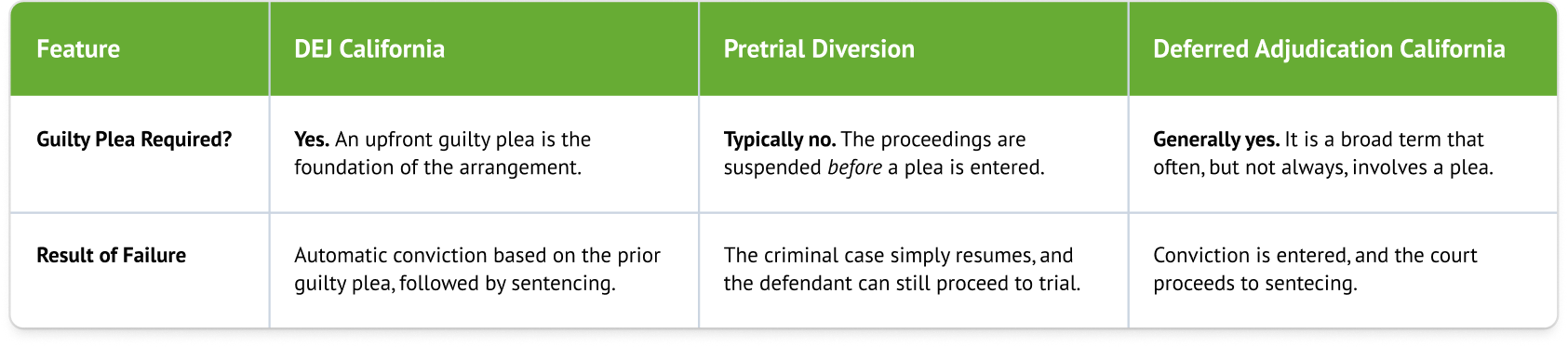
DEJ vs. Diversion Programs and Deferred Adjudication
It is common to confuse DEJ with other legal options. The differences are critical.
Juvenile Deferred Entry of Judgment in California
The juvenile justice system offers a similar path for minors, governed by Welfare and Institutions Code 790 and California Rules of Court, Rule 5.800, deferred entry of judgment.
A juvenile adjudication is meant to provide young offenders with rehabilitative services without exposing them to long-term consequences.
Eligibility is determined using the JV-750 DEJ eligibility form. If the minor qualifies and admits to the offense, the court puts the case on hold.
The minor must complete a program of supervision with terms like mandatory school attendance, counseling, and community service. Upon successful completion, the petition is dismissed, and their records can be sealed.
Conclusion
The deferred entry of judgment, the California program serves a vital role in the state's justice system. It offers a meaningful opportunity for individuals facing certain non-violent charges to take responsibility and work toward a clean record.
DEJ offers eligible participants a constructive way to move forward following a criminal conviction by focusing on rehabilitation.
However, the requirement of a guilty plea and the strict terms of probation make it a serious commitment that should be carefully considered with legal counsel.
For those looking to deepen their understanding of complex legal frameworks and intervention programs, CT3 training can help expand your expertise. You can also explore how Deferred Judgment works in Iowa.
Frequently Asked Questions (FAQs)
What is deferred entry of judgment in California?
It is a sentencing alternative where a defendant pleads guilty, but the court holds off on entering a conviction. If the defendant completes a term of probation and its conditions, the charges are dismissed.
How does DEJ work in California?
A defendant enters a guilty plea. In exchange, the court places them on probation with specific requirements. By fulfilling all these requirements for the entire probationary period, the defendant earns a dismissal of the charges, thereby avoiding a conviction.
What is the deferred entry of judgment eligibility in California?
Eligibility for DEJ California is strict and typically limited to first-time, non-violent drug offenders. A defendant cannot have prior drug convictions or any felony convictions within the previous five years.
How to get DEJ in California?
DEJ must be offered by the prosecution and approved by a judge; it cannot be demanded. A defense attorney must negotiate with the prosecutor to demonstrate that the defendant is a suitable candidate for the program.
What are the DEJ California requirements and probation terms?
Terms are rehabilitative and often include mandatory drug treatment or counseling, regular drug testing, community service, payment of fines or victim restitution, and abstaining from any new criminal activity.
What is juvenile deferred entry of judgment in California?
It is a parallel program for minors under the Welfare and Institutions Code 790. It allows a juvenile to admit to an offense in exchange for a period of supervision. Successful completion results in the dismissal and sealing of their case.
What is the difference between DEJ and diversion programs in California?
The main difference is the guilty plea. DEJ California requires a guilty plea upfront. If you fail, you are convicted. Many pretrial diversion programs do not require a plea, so if you fail, your case simply continues, and you can still fight the charges.
What are the differences between DEJ and deferred adjudication in California?
Deferred adjudicationin California is a broad term for postponing a conviction. DEJ California is a specific, formal program created by statute with its own explicit rules, primarily for drug offenses.
.svg)


